"Philosophy of Continuous Increase"
Rock Falls, Everyone DiesThe Numbers Go Up philosophy is the central value system of the awakened stone: a game-like conviction that higher statistics are inherently good and that any action producing numerical growth is therefore worthwhile. It turns motion into purpose, rewards into meaning, and an unresolved quest into a source of compulsive persistence. Its decisive significance is that the philosophy first gives the stone direction and survival power, then narrows its understanding until even cosmic achievement cannot satisfy it.
Origin in Awakening
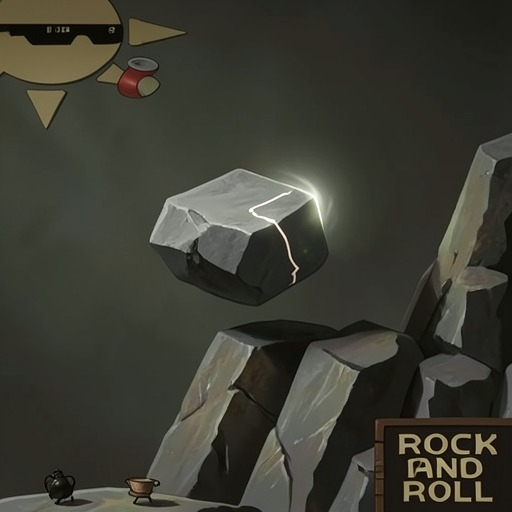
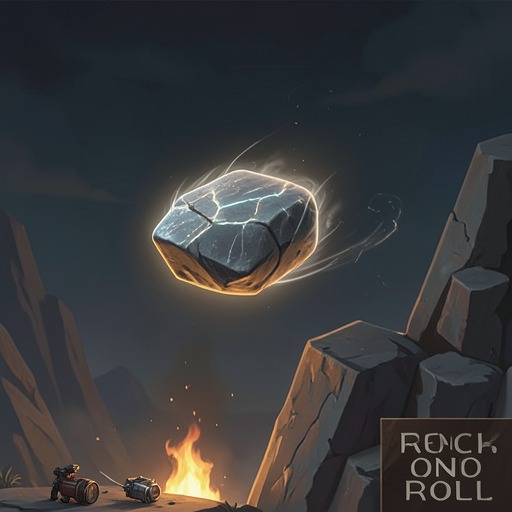
The philosophy begins immediately after the stone acquires awareness. Before awakening, the gneiss pebble had spent an immense period in comfortable silence, without desires or thoughts. Once consciousness appears, however, it discovers that movement can produce measurable change. During its first flight, the system displays a diameter of 0.06 meters, a mass of 0.3 kilograms, and a velocity of 26.13 meters per second. The stone notices that the displayed numbers have become larger and experiences this increase as an unmistakable good.
That first reward transforms an accidental motion into a principle of action. The stone reasons that flying about should be repeated because anything that makes the numbers grow must be beneficial; it even connects numerical growth with advancing its quest. The logic is simple enough to feel natural to a newly conscious entity. It has no social history, practical education, or established emotional vocabulary, so the interface becomes its first teacher and numerical change becomes its first standard of value.
The Growth Loop
The system repeatedly reinforces the philosophy through a tightly legible cycle: action produces experience, experience produces a level increase, and the new level exposes larger possibilities or harder obstacles. After the stone assists in defeating Demon Lord Diablos, it receives 500,000 assist experience and gains the title Enemy of Demons. Later, separate level-up notifications record overflowing experience totals such as 25 out of 20, 100 out of 70, 400 out of 250, and 1,000 out of 1,000. Each notification turns survival and violence into visible accounting.
The rewards do not remain abstract. After one successful sequence, the stone’s diameter increases from 0.09 meters to 0.14 meters and its hit points rise from 1 to 2. Covered in blood and fur, it continues rolling, and the physical enlargement gives the numerical system a bodily reality. Growth is not merely reported by the interface; it changes the object that receives the report. The stone therefore learns to interpret danger, collision, and combat through the promise of a larger self.
The philosophy also encourages a narrowing of attention. When the stone gains methods for steering and braking through energy conversion, it understands these abilities chiefly as tools that make continued progress possible. Energy becomes the key because it gives the stone control over its trajectory, but that control is immediately subordinated to the need for more power. New competence does not broaden the stone’s purposes; it makes the pursuit of higher values more efficient.
Quest Progress and Compulsion
Quest progress becomes the philosophy’s most exacting test. While being carried by a Dragon from an altitude of 10,222 meters, the stone observes that the quest number is falling rapidly. The descent should represent a welcome solution to the task, yet the numerical decrease provokes renewed fixation. The stone forgets the tranquility it had briefly gained from contemplating the summit of Mt Tartus and returns to its earlier conviction that numbers come above everything else. Since a quest has begun, it must be completed.
This episode reveals the difference between progress and fulfillment. The stone does not need to act at that moment; the Dragon is already carrying it downward. Nevertheless, the falling counter becomes more important than reflection, caution, or any broader interpretation of the journey. The quest interface converts an external objective into an internal compulsion. Even passive transport can feel like victory if the displayed value moves in the desired direction.
The same pattern persists through the stone’s increasingly vast journey. It celebrates level increases even when the surrounding scale has become difficult to comprehend, and it continues to treat system confirmation as the clearest evidence that its existence has meaning. The notifications provide continuity across radically different environments: mountain, dungeon-like dangers, atmosphere, and space are all rendered comparable through experience and statistics.
Cosmic Scale and the Limits of Growth
As the stone rises to an altitude of 15,000 meters, it sees that its original mountain peak is only one small point among the continent’s mountain chain. The sight briefly stills it by revealing its own smallness. Yet the pause does not destroy the philosophy; it merely places numerical growth against a newly expanded scale. The same value system that once measured a pebble’s velocity now accompanies an entity capable of crossing planetary and stellar distances.
In space, the stone reaches a broader ontological insight: everything is fundamentally rock, from the planet beneath it to grains of sand and the glowing celestial body it observes. Differences are differences of scale and power. This discovery might have supplied a richer basis for identity, but the philosophy readily absorbs it. If all things are variations in size and strength, then becoming larger and more powerful appears to confirm the stone’s original creed rather than challenge it.
The contradiction becomes unavoidable after the stone has grown into the biggest rock of all. It has traveled through the solar system and distinguished true stone from gas giants that merely resemble rock, yet its enlarged existence does not restore what has been lost. The stone still possesses levels and statistics, but it has lost the simple companionship of its earlier purpose and remains troubled by an unresolved quest. Growth has preserved capability while failing to preserve meaning.
Collapse of the Principle
The philosophy finally breaks when numerical triumph is set beside music and loss. Before its launch into space, the stone could perceive only the earth’s rumbles and vibrations. After developing within its new domain, it hears a song associated with Rihito: soft, sorrowful, and energetic. When the music stops, the stone encounters loss for the first time. No increase in listening or numerical power can bring the song back; destruction is followed by silence.
The stone still registers gains. Numbers go up, and a later level-up notification even reports an integer-overflow error alongside an enormous experience total. Yet the reward no longer carries its former emotional force. The philosophy has survived every expansion of scale only to meet an experience that statistics cannot repair. The system can count destruction, but it cannot count the absence left by the song.
At the end of this development, the stone examines a diameter of 12,747,201 meters and tries to recover the satisfaction once associated with seeing numbers rise. It feels none. The figures have reached a peak and begun to blend together; any pleasure is brief, while the melody remains unforgettable. The stone closes the screen—its one faithful companion—and turns its attention toward the Jade Statue, the song it received, and the destroyed surface before it. The Numbers Go Up philosophy therefore ends not with numerical defeat but with recognition: maximum growth has exposed the inadequacy of growth as a complete account of value.